
Enroll Your Breed
Conservation Genetics · Breed Health · Long-Term Population Science
Preserve Your Breed's
Genetic Future
BetterBred partners with breed communities to build the foundational genetic data your breed needs — to preserve the existing diversity within your breed before it is quietly lost, generation by generation.
Assess
Gather a carefully stratified sample of 50 dogs from diverse lines, regions, and uses within your breed.
~50 dogs · ~$2,500Analyze
We calculate breed-specific allele frequencies, establish population baselines, and build your breed's diversity profile.
2–3 weeks after UC Davis receives samplesAct
Breeders access tools to identify each dog's contribution to the breed's genetic future, learn what they mean and how to use them, and plan litters accordingly.
Actionable data · free courses includedBy the time breeders see a health problem,
the genetics driving it have already spread
Purebred dogs live in closed populations. Closed populations allow breeders to reliably reproduce type, temperament, and working ability — but the same closure that preserves what breeders love also concentrates the genetic combinations that underlie complex disease in the breed, generation after generation, long before disease incidence rises.
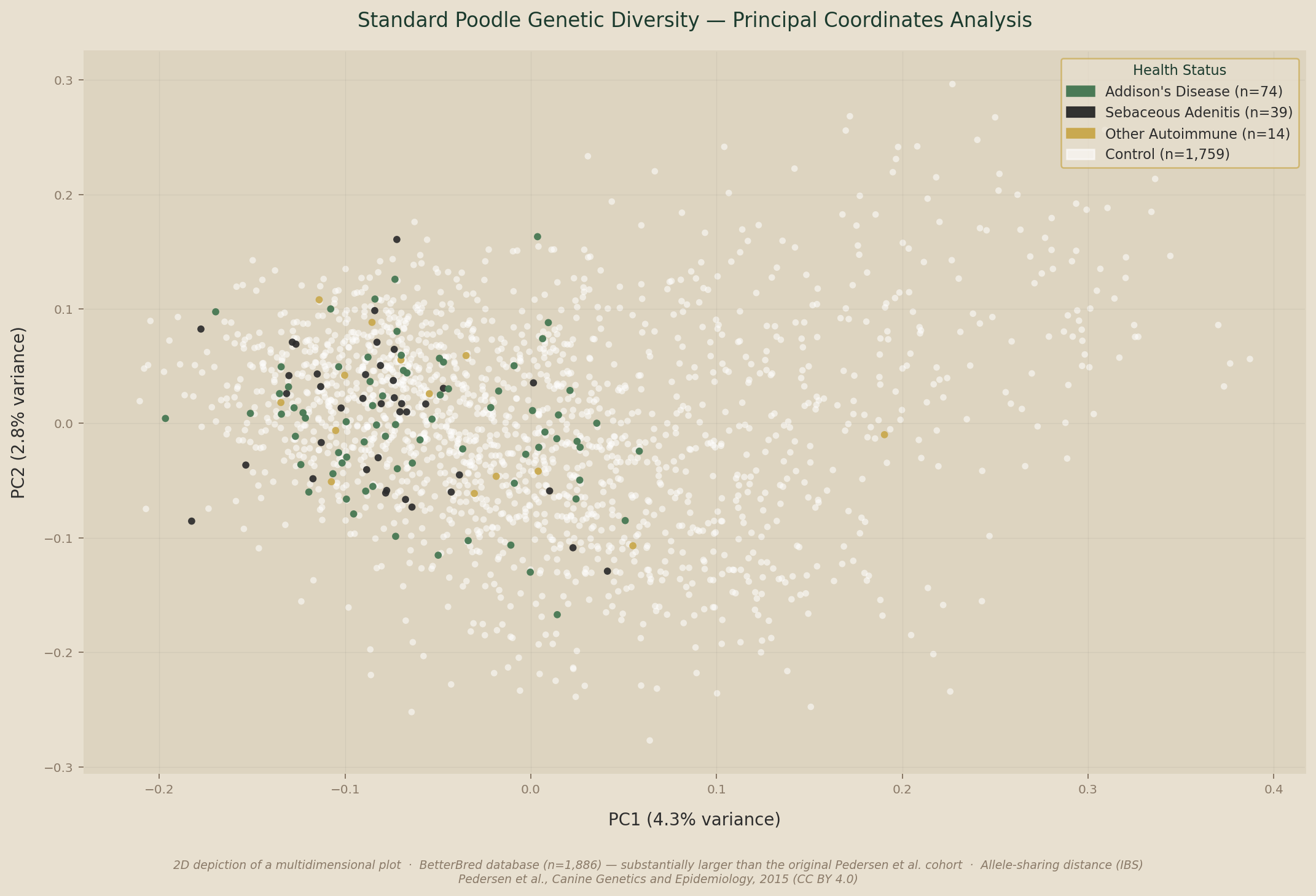
This isn't the story of a single faulty gene. Complex conditions — autoimmune disease, metabolic disorders, breed-specific cancers — are driven by additive genes: many variants, acting in combination, spread invisibly through a population. By the time disease rates visibly climb, the genetics enabling them are already pervasive.
 Click to enlarge ↗
Standard Poodle genetic diversity — 1,886 dogs plotted by allele-sharing distance. Affected dogs (Addison's, sebaceous adenitis) concentrate toward the more genetically similar core of the population. 2D depiction of a multidimensional plot · BetterBred database · Pedersen et al., Canine Genetics and Epidemiology, 2015 (CC BY 4.0)
Note: Autosomal recessive diseases are comparatively findable through runs of homozygosity — SNP chips like those used by other companies identify these well. BetterBred's tools address the harder, complementary problem: the slow loss of allelic richness that underlies complex disease.
What BetterBred Measures
Allele Frequency Distribution
Breed-specific frequencies across all STR loci — not just whether a dog is heterozygous, but which of a range of alleles it carries at each locus and how common they are within your breed's tested population.
Outlier Index (OI)
A measure of how valuable each dog is for conserving the breed's genetic diversity. Thoroughly tested, in the field and the lab, this is arguably the most informative available measure breeders need.
Internal Relatedness (IR)
A measure of genome-wide homozygosity, used in research worldwide. A reliable, tested measure of inbreeding or outbreeding in an individual dog.
Longitudinal multi-generational data
As breeds grow in the database across years and generations, BetterBred tracks how allele frequencies shift — providing long-term population monitoring no other breeder tool offers.
Pedersen NC, Brucker L, Tessier NG, et al. The effect of genetic bottlenecks and inbreeding on the incidence of two major autoimmune diseases in Standard Poodles. Canine Genetics and Epidemiology, 2015.
What BetterBred does that
no other tool currently provides
Breed-referenced tools built around allelic richness, not just inbreeding
Other diversity tools calculate breed-referenced inbreeding scores — how homozygous a dog is relative to its breed. BetterBred calculates something different: each dog's contribution to its breed's allele frequency distribution, recalculated dynamically as the population grows across generations. The baseline isn't static. It moves with the breed.
A different question, not just a different toolOutlier Index: which dogs to keep, not just which pairings to avoid
Other diversity tools tell you what to avoid. BetterBred tells you what to keep — highlighting which dogs in any line or litter carry the alleles your breed is quietly losing. Avoiding inbreeding protects individual dogs. Knowing which ones to breed forward is what protects the breed.
Proprietary to BetterBredMulti-generational longitudinal tracking
BetterBred has tracked breeds across multiple generations of dogs — not just a snapshot. Breeders can see how allele frequencies are shifting over time and whether the breed's genetic diversity is genuinely being preserved or quietly eroding. No other breeder tool provides this.
Unique to BetterBredGenetic diversity is not the same thing as heterozygosity
Heterozygosity is a result, not a resource. What produces heterozygous offspring is having enough variation in the gene pool that two different alleles are likely to meet. That variation — allelic richness — is what disappears when populations shrink, when popular sires dominate a generation, when the same lines are bred repeatedly. Once it's gone, no pairing strategy brings it back.
BetterBred's goal is to slow that loss: identifying which dogs in any line or litter carry the alleles most at risk of disappearing, and highlighting them for breeding. When variation is preserved, heterozygosity follows. Saving what exists is how you breed more heterozygous dogs.
STRs and SNPs do different things well. When you test each one against the other's strengths, it can look like one is simply better. It isn't. They're very different tools built for different questions.
What a successful breed
enrollment requires
The Sample
- A minimum of 50 dogs — a well-chosen 50 captures most existing allelic diversity
- Dogs from unrelated or minimally related lines — no first-degree relatives
- Representation across geographic regions where the breed is established
- Inclusion of different lines: show, working, hunting, sport, color lines where applicable
- UC Davis Veterinary Genetics Laboratory STR diversity test for each dog
The Breed Representative
- A breed club officer, health foundation representative, or dedicated breeder with standing in the community
- Ability to coordinate initial testing across multiple breeders
- Commitment to ongoing enrollment — the database grows in value as more dogs are added
- Answers our questions about the breed — things only someone inside the breed really knows
- Explains to their community how the project works and what it asks of breeders — BetterBred handles all questions about the science and the tools
- BetterBred coaches all breed representatives on sampling strategy at no charge
Why 50 dogs is sufficient for a reliable baseline
A well-stratified sample of 50 dogs — drawn from unrelated lines across different regions and specialties — captures most of the allelic diversity present in a breed. In BetterBred's experience across 54 enrolled breeds, the allele frequencies found at 50 dogs do not change substantially once the database reaches 500. What a larger database adds is greater statistical confidence and the ability to detect finer population structure — valuable refinements, but not prerequisites for breeders to begin making better decisions.
What initial enrollment
actually costs
Initial Assessment Costs
The $2,500 initial testing cost is typically shared across participating breeders — many breed clubs subsidize some or all of it through health foundation grants. BetterBred does not charge for the initial setup, database creation, or breed coaching.
Ongoing costs are borne by individual breeders who choose to subscribe ($499/year or $49/month) for access to the full toolset. Free accounts can view and submit dogs and access basic comparison tools.
Tell us about
your breed
We respond to every inquiry personally. The first conversation is always about understanding your breed's situation and whether BetterBred is the right fit.
Breed Enrollment Inquiry
All fields help us prepare for our first conversation. Nothing is binding.