Breed Page

Giant Schnauzer — BetterBred Breed Page – BetterBred.com
BetterBred Breed Profile

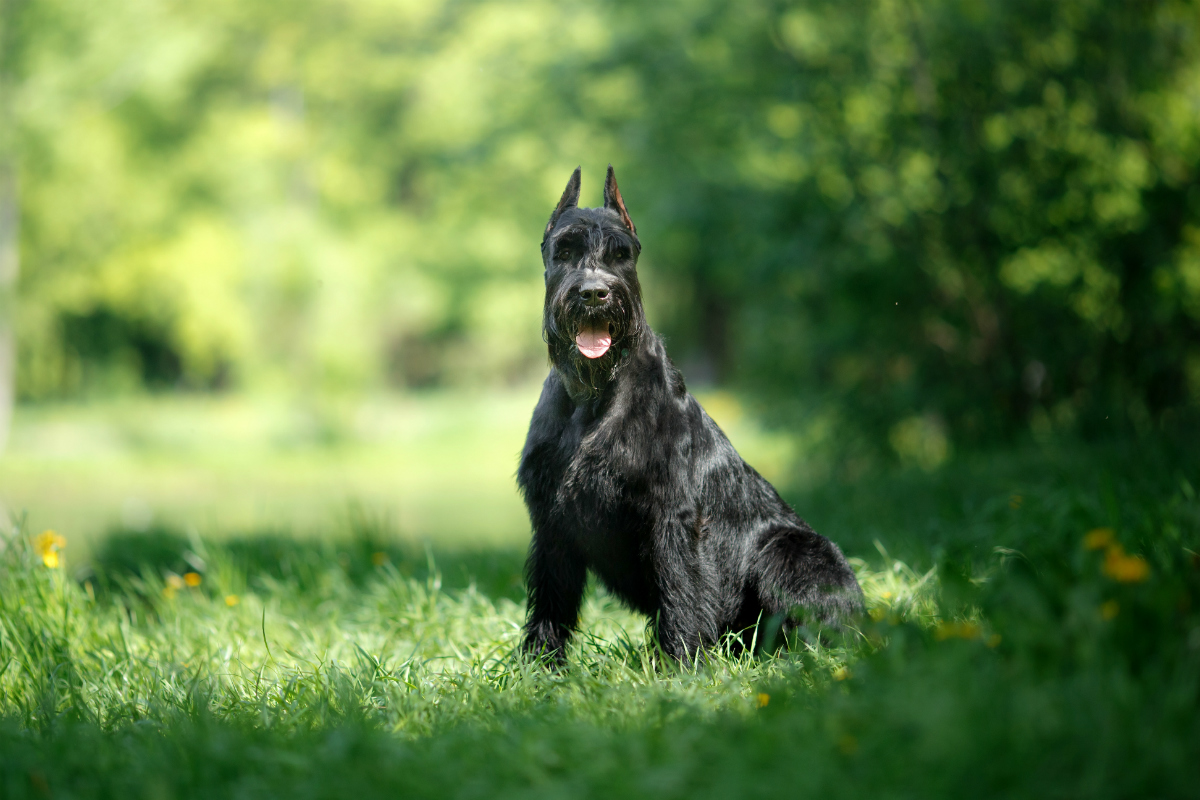
Giant Schnauzer

Temperament: Powerful, spirited, and deeply loyal. Giant Schnauzers are serious working dogs - intelligent and trainable, but also strong-willed and requiring a confident, consistent handler. They are composed and watchful in repose and commanding when aroused, with strong protective instincts. They need real daily work and benefit from early socialization.
Height: Males: 25.5-27.5 inches (65-70 cm), Females: 23.5-25.5 inches (60-65 cm)
Weight: Males: 60-85 pounds (27-39 kg), Females: 55-75 pounds (25-34 kg)
Life Span: 11-14 years
Outlier Index ?
0.26
Born before 2016: 0.27 Born after 2024: 0.24
Avg Genetic Rel. ?
0.00
Born before 2016: -0.01 Born after 2024: 0.02
Internal Relatedness ?
0.04
Born before 2016: 0.04 Born after 2024: 0.12
Giant Schnauzer
#NameGender OIAGRIR
1 Trouble Always Finds Me Von Der Zetterhoff F 0.30 -0.09 0.09
2 Firezone's Radiantly Singular F 0.24 0.02 0.12
3 Grande Crazy Little Thing Called Love F 0.21 0.07 -0.04
4 Grande Something About Merrie F 0.24 0.03 0.06
5 Firezone's Bright Light of Fire M 0.22 -0.02 0.14
6 Firezones Power of Three F 0.16 0.08 -0.04
7 CH Zarina's Design American Idol M 0.17 0.02 0.25
8 Firezone's Take The Risk F 0.29 -0.04 0.03
9 Hearthmore's Honky Tonk Woman F 0.16 0.07 -0.03
10 Hearthmore's Kestrel F 0.13 0.10 -0.01
The Giant Schnauzer was developed in Bavaria in the late 19th century from the Standard Schnauzer, with contributions from larger working breeds including Great Dane, Bouvier des Flandres, and possibly Rottweiler. The goal was a cattle-driving and guard dog hardy enough for farm and brewery work. By the early 20th century the breed had found additional roles as a police and military working dog, and it remains a serious working breed today. Both World Wars affected the breed's continental European population, and the modern worldwide gene pool reflects rebuilding efforts from that period. Two color varieties - solid black, and pepper-and-salt - are recognized and have largely been bred separately, which has shaped the breed's genetic structure.
Hip dysplasia, elbow dysplasia, and progressive retinal atrophy occur. Autoimmune conditions including autoimmune thyroiditis are concerns. Cancer, particularly squamous cell carcinoma of the toe and osteosarcoma, occurs at elevated rates. Epilepsy has been reported. Gastric dilatation-volvulus (bloat) is a significant risk given the deep chest and large size.
VGL has reported Giant Schnauzers carrying an average of around 7.48 alleles across the 33 STR loci, with an effective allele count near 3.51. Those are respectable numbers, with the usual gap between average and effective alleles indicating a subset of common alleles dominates. Preserving rarer alleles through thoughtful pairings should remain a priority. VGL testing has found Giant Schnauzers with observed heterozygosity below expected, giving a modestly positive inbreeding coefficient. That reflects the breed's separation into black and pepper-and-salt varieties and the founder effects from the 20th-century rebuilding period. Individual IR values still vary and breeders have room to actively pair less related dogs, including across the color varieties where that is acceptable in the breeding program.

Average metrics by birth year for dogs with recorded birthdates in the BetterBred database.

A 3D genetic map of enrolled Giant Schnauzer dogs in the BetterBred database, based on allele-sharing distance across 33 STR loci. This is not a complete picture of the breed — it reflects only dogs whose owners have enrolled them. Drag to rotate · scroll to zoom · hover for dog names (public profiles only).

Historical founders — oldest 25% of enrolled dogs     Current gene pool — most recent 50% of enrolled dogs
Building plot… this may take a minute for larger breeds.

The Dog Leukocyte Antigen (DLA) region controls immune function and is the most polymorphic portion of the canine genome. Every dog carries two sets of DLA haplotypes — one from each parent — which almost never recombine across generations. Frequency percentages reflect how often each haplotype appears across all allele copies in the breed, not the percentage of dogs carrying it.

Class I Haplotypes

HaplotypeFrequency
1092
28.0%
1014
20.7%
1159
16.4%
1017
8.9%
1068
6.7%
1006
5.1%
1016
4.7%
1008
4.4%
1091
2.7%
1011
1.1%
1065
0.4%
1181
0.4%
1067
0.2%
1054
0.2%
1263
0.2%

Class II Haplotypes

HaplotypeFrequency
2037
34.9%
2006
14.7%
2050
13.8%
2090
8.9%
2053
7.6%
2007
5.1%
2031
4.2%
2003
3.6%
2033
3.1%
2012
1.1%
2005
0.7%
2001
0.7%
2014
0.6%
2060
0.4%
2017
0.2%
2022
0.2%
2076
0.2%

Class I & II Combinations

Class IClass IIFrequency
1092 2037
28.0%
1159 2006
14.7%
1014 2050
13.8%
1017 2090
8.9%
1014 2037
6.9%
1068 2053
6.7%
1006 2007
5.1%
1016 2031
4.2%
1008 2003
3.6%
1091 2033
2.7%
1011 2012
1.1%
1159 2053
0.9%
1008 2005
0.7%
1159 2001
0.7%
1016 2014
0.6%
1065 2033
0.4%
1181 2060
0.4%
1067 2017
0.2%
1054 2022
0.2%
1263 2076
0.2%

The Canine Diversity Test from UC Davis Veterinary Genetics Laboratory is the foundation of BetterBred’s breed management tools. Testing your dog adds to the breed database and gives you access to the full suite of breeding analysis tools.

Order from UC Davis VGL →
Wasserlauf Giant Schnauzers
Ontario, CA
Visit Website →
Kiraly Giant Schnauzers
British Columbia, Canada
Visit Website →
Draxpark Giant Schnauzers
North Yorkshire, UK
Visit Website →
Grande Giant Schnauzers
Colorado, US
Visit Website →
Indigo Giants
Missouri, US
Visit Website →

BetterBred does not personally endorse or recommend any listed kennel. Visitors are responsible for conducting their own research, including verifying health testing records and speaking directly with breeders. List your kennel →